Wealth Delta Tax
The Wealth Delta Tax taxes Net Worth when it rises, refunds when it falls.
All existing concepts about traditional taxation do not apply because of this single property.
Independent research · 32 working papers · open to challenge · DOI: 10.5281/zenodo.21964119
The idea in one minute
Imagine three people, each worth £100 million at the start of the year.
- Alice is still worth £100 million at the end of the year. She pays nothing.
- Ben is worth £120 million. He pays tax on the £20 million increase.
- Charlie is worth £90 million. He receives a refund on part of the £10 million fall.
Under the current system, Ben could make that £20 million gain, never sell the asset, and pay no tax on it at all — not this year, not next year, possibly never. The WDT exists because it treats that increase in wealth as economically real whether or not Ben chooses to sell.
How the system works
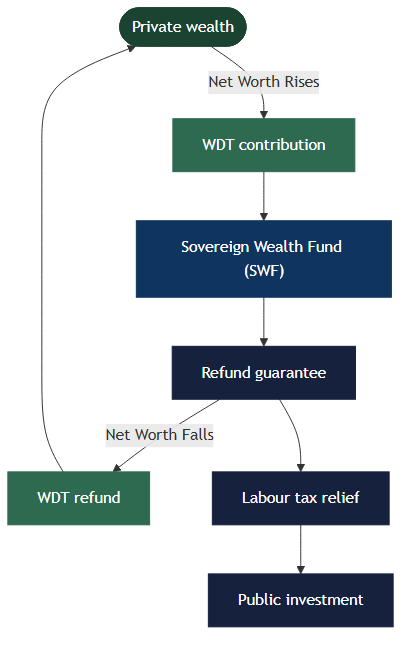
The system is bidirectional. Private wealth does not simply flow to government — the connection runs both ways.
The symmetry
Most taxes move in one direction: private wealth to government. WDT moves in both.
| ↑ your wealth rises | You contribute |
| ↓ your wealth falls | You receive a refund |
| → your wealth is unchanged | Nothing happens |
WDT is better understood as a fiscal participation rule than as a tax on being wealthy.
Why the current system falls short
Most people already accept that wages should be taxed. But if your investment portfolio grows by the same amount as your colleague’s salary, you often pay nothing. The tax is triggered only when you sell — and in some cases is eliminated entirely at death.
Consider a strategy sometimes called “buy, borrow, die.” An investor holds an asset worth £10 million that has appreciated substantially but has never been sold, so has never been taxed. Rather than selling, they borrow £10 million against it and live off the loan. Their net worth is unchanged — the new cash and the new debt cancel out — and no taxable event has occurred. The asset appreciated for decades. The state saw none of it.
The WDT closes this automatically. Because the tax base is net worth (assets minus liabilities), borrowing against an asset is neutral by construction. But the asset’s annual appreciation enters the tax base each year as it accrues — so there is nothing left to defer by borrowing against it. The loophole closes not through a new rule, but because the thing the loophole was exploiting no longer exists.
What the money is for
WDT revenue is dedicated to reducing taxes on wages and consumption — income tax, National Insurance, and VAT. The people benefiting most from long-run wealth accumulation bear a greater share of the cost of maintaining the systems that made that accumulation possible.
Consider Sarah, who earns £38,000 a year. The WDT threshold is in the region of £2 million in net worth. She would need to save every penny of her salary for over a century to reach it. She will never pay the WDT. But she currently pays income tax and National Insurance on every pound she earns, and VAT on most of what she spends. Under a mature WDT, those are the taxes that fall. The people above the threshold pay the WDT; Sarah gets the relief.
How much relief? At median earnings of £39,039, removing income tax and National Insurance contributions returns £618 per month to the payslip. Once VAT displacement and energy cost reductions are included, effective purchasing power rises by 36% from the same employment — without a pay rise, without a promotion, without any change in Sarah’s working life. A lower earner on £25,000 gains £320 per month on the payslip and 32% in effective purchasing power. These are not projections of what a government might choose to do with surplus revenue. They are the arithmetic consequence of what the WDT’s reserve accumulation is constitutionally committed to deliver.
→ Full purchasing power analysis [(LDW)](ldw.html)
The Sovereign Wealth Fund
The WDT does not merely finance today’s government. It builds an asset. Contributions accumulate in a Sovereign Wealth Fund, managed at arm’s length from the Treasury, invested on long horizons.
The fund serves three purposes simultaneously:
- Refund guarantee — pre-funds the state’s obligation to pay refunds in bad years, making the promise mechanically credible rather than aspirational
- Labour Tax Relief — accumulates the reserves from which income tax and National Insurance are progressively displaced
- Public Investment — generates long-run returns reinvested in infrastructure and public capital
Without the fund, a government facing a market crash could simply not pay the refund. With it, the obligation is backed by a ring-fenced asset that cannot be suspended without breaching a funded constitutional commitment — not merely breaking a promise.
A government that raids the SWF is not changing a policy. It is defaulting on a debt.
→ How the fund is governed and protected [(GOV)](gov.html)
“Isn’t this just a wealth tax?”
| Conventional wealth tax | WDT | |
|---|---|---|
| What is taxed | The stock of wealth | The annual change in wealth |
| Direction | One-way | Symmetric: up and down |
| What happens to the money | General revenues | Dedicated Sovereign Wealth Fund |
| When wealth falls | Nothing — you still owe tax on the stock | You receive a refund |
| Conceptual frame | Revenue extraction | Shared exposure to wealth movement |
→ See the full list of objections and answers · → Detailed three-way comparison
Sceptical?
- How do you value assets that don’t trade publicly? → FAQ Q3 · VAL
- What stops the wealthy from leaving? → FAQ Q4 · CLOSE
- Wouldn’t this destroy investment incentives? → FAQ Q7 · BEHAV
- What stops government from raiding the fund? → FAQ Q10 · GOV
- How does this work for private companies? → FAQ Q4 · CORP
- Why would this ever become law? → FAQ Q8 · POL
Where to go next
| If you want… | Start with… |
|---|---|
| The full mechanism | White Paper [(WP)](wp.html) |
| The moral case | Moral Foundations [(MF)](mf.html) |
| The numbers | Rates and Revenue [(RATES)](rates.html) |
| What this means for your household | Labour Dividend Welfare [(LDW)](ldw.html) |
| The hardest objections | FAQ |
| All 32 papers | Research Programme |
| Everything | Project Map |
32 working papers in active development as of mid-2026. Pre-peer review. Open questions are stated explicitly throughout and collected in the Project Map.